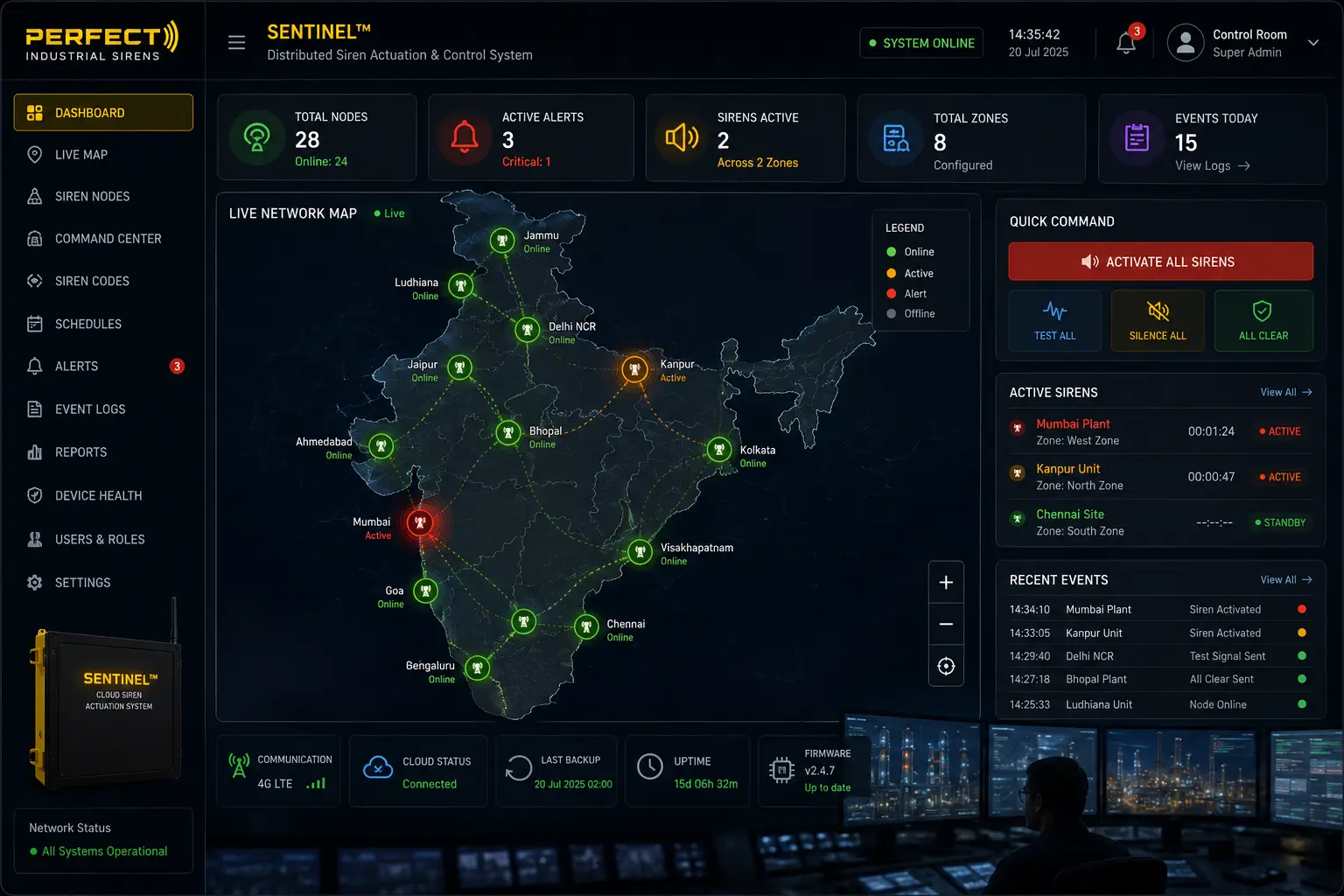
Unified Siren Control System — One-Click Multi-Location Siren Activation
New Product — Now Available
Distributed Siren Control

One Click.
Every Siren. Any Location.

The Unified Siren Control System lets you activate, schedule, and monitor any number of sirens across physically separate locations — from a single centralised control point over a network.

2+
Min. Devices
5A
Max Load / Unit
220V
AC Input
Master–Slave Network Architecture
Unified Siren Control System — Network Central Controller Zone A Siren Motor siren Zone B Siren Motor siren Zone C Siren Motor siren Zone D Hooter array Zone E Flameproof LAN/IP RS-485
Unified distributed siren actuation and control system — master slave architecture, centralised dashboard, multi-site, India
Architecture
Master / Slave
Dashboard
Centralised web-based
Actuation
Remote & local
Logging
Full event log with timestamp
Health
Real-time device monitoring
Service
Annual service contract
The Problem This Solves

When Your Sirens Are in Different Places
But Your Control Room Is in One Place

Large industrial campuses, multi-building factories, and distributed pipeline networks all face the same challenge: sirens are spread across physical locations, but activating them requires someone to be physically present at each one.

No Central Activation

Triggering sirens at Gate 1, Building 3, and the storage yard simultaneously requires either wiring across the entire campus or three people in three locations at the same time — neither is practical.

No Event Logging or Audit Trail

Manual siren systems leave no record. When did the emergency siren fire? Which zone? Who triggered it? For OISD/ERDMP compliance, an event log is mandatory — and impossible with standalone systems.

No Remote Health Monitoring

You don't know if a siren at a remote location is working until you need it and it doesn't fire. Without health monitoring, siren failures go undetected until an emergency exposes them.

How It Works

Master–Slave Architecture Explained

The system uses a Master–Slave network topology. One Master unit runs the central control software. Multiple Slave units are installed at each siren location. All units communicate over your existing network — LAN, Wi-Fi, or GSM.

M

Master Unit — Central Controller

Installed at your control room or safety officer's station. Runs the dashboard software. Sends commands to all Slave units. Records all events. Monitors system health in real time. One Master manages all connected Slaves.

S

Slave Units — Remote Siren Controllers

One Slave unit per location. Each Slave connects to the local siren (220V AC, up to 5A). Receives commands from the Master and actuates the siren. Reports status back. Minimum 2 Slave units required per installation — one Master is in addition to this.

N

Network — LAN / Wi-Fi / GSM

Master and Slave units communicate over your facility network. For locations without LAN access, GSM connectivity is supported. No new cabling required between Master and remote Slave units.

Engineering Insight

When to Choose Distributed Actuation vs Hardwired Multi-Zone

Traditional multi-zone siren control uses a single ASC panel with hardwired connections to each siren. This works well when all sirens are within 200–300 metres of the panel. Beyond that, cable costs and voltage drop become significant. The Distributed Siren Actuation System eliminates the cable run entirely — each Slave unit is powered locally from the nearest 220V supply, and commands travel over the existing data network at negligible cost.

  • Use distributed when sirens are more than 300m from control room
  • Use distributed when sirens are on separate buildings with no conduit path
  • Use distributed for multi-campus or township-wide notification
  • Use hardwired ASC panel when all sirens are within the same compound
  • Hybrid approach: ASC panel for local zones + distributed for remote locations
  • Each Slave unit needs local 220V supply — check availability at each location
  • External starters not included — for sirens above 5A, add external contactor
Features

What the System Gives You

Centralised Activation

Activate any siren, any zone, or all zones simultaneously with a single click from the Master dashboard. No physical presence required at remote siren locations.

Programmable Siren Patterns

Configure custom siren patterns for each zone: duration, on/off cycles, repeat count. Different patterns for shift change, fire alert, gas leak, and all-clear.

Scheduling

Pre-programme siren events by time and date. Shift change sirens fire automatically at scheduled times — no operator action required once programmed.

Event Logging

Complete audit trail of every siren activation — time, date, zone, trigger source (scheduled/manual/emergency). Downloadable for compliance reporting and safety audits.

Health Monitoring

Real-time status of every Slave unit on the dashboard. Instant alert if any unit goes offline or loses connectivity. Know your sirens are ready before you need them.

Software Access Included

Dashboard software access is included with the system for the first year. Annual service renewal applicable from Year 2 onwards, with continued updates and support.

Specifications

Technical Specifications

Specifications for the standard Unified Siren Control System.

ParameterSpecification
ArchitectureMaster–Slave, networked
Minimum Devices1 Master + 2 Slave units (minimum)
Siren Output220V AC, up to 5A per Slave unit
NetworkLAN (Ethernet) / Wi-Fi / GSM
Control InterfaceWeb dashboard (software access included)
Siren PatternsFully configurable — duration, cycles, repeat
SchedulingTime and date-based programmable events
Event LoggingComplete audit trail, downloadable
Health MonitoringReal-time status of all Slave units
Software Access1 year included; annual renewal applicable
External StartersNot included — required for sirens above 5A
Siren CompatibilityAny 220V AC industrial siren up to 5A
Power Supply220V AC at each Slave unit location
Applications

Where This System Is Used

Large Industrial Campuses

Multi-building plants where sirens span 1–5 km across — all activated simultaneously from the control room.

Pipeline & Pump Stations

Remote unmanned pump stations along a pipeline — central control can activate sirens at any station for maintenance or emergency.

Multi-Location Companies

Group companies with factories in different cities — head office can trigger emergency sirens at any site instantly.

Defence & Government

Secure campuses where centralized alert systems are required with a full event log for compliance and accountability.

Before You Order

Important Product Notes

Be aware of these product specifics before placing an order — they affect installation planning.

⚠ Minimum 2 Devices Required

The system requires a minimum of 2 Slave units plus 1 Master unit per installation. A single-slave installation is not supported. Plan your network topology accordingly before ordering.

ℹ External Starters Not Included

Each Slave unit can directly drive sirens rated up to 220V AC, 5A. For motor sirens above this rating, an external contactor or starter is required at the siren location — this is supplied separately and is not included with the system.

🔄 Annual Service Renewal

Software access, system updates, and technical support are included for the first year. From Year 2 onwards, an annual service renewal fee applies. Renewal ensures continued dashboard access and support.

FAQ

Distributed Siren System — Questions

Common questions about the Unified Siren Control System.

Discuss Your Requirement
The number of Slave units supported by a single Master depends on the network configuration. For most standard installations, a single Master can control multiple Slave units across a facility network. The exact maximum is confirmed during project scoping — share your number of locations and we will advise the right configuration.
The Master and Slave units communicate over standard IP networks. You can use your existing LAN / Ethernet network, Wi-Fi, or GSM connectivity for locations without fixed network access. No proprietary cabling is needed between units — only a 220V AC supply at each Slave location and network connectivity.
If the Master and Slaves are on the same local area network (LAN), the system continues to function even without internet connectivity — LAN-based communication is independent of internet access. For GSM-connected remote Slaves, connectivity depends on mobile network availability at the installation site.
The event logging and audit trail features of this system directly support OISD and ERDMP compliance documentation requirements. However, for full OISD-117 / ERDMP compliance, the system should be used in conjunction with our Advanced Siren Control Panel (ASC), which provides the mandatory siren tone codes, manual override panel, and compliance documentation. We can design a combined system to meet your specific standards.
The Master dashboard immediately shows the affected Slave unit as offline and generates an alert. The remaining Slave units continue to function normally. The disconnected Slave unit can be configured to fail-safe (siren off) or fail-secure (siren continues last command) — this is set during system configuration based on your safety requirements.
Related

You May Also Need

Need a unified siren control network?

Share your site layout, number of zones, and trigger requirements. We design and quote within one working day.

Also see: Motor Siren →GSM Remote Siren →Factory Warning System →
📄 IP-based alarm system specs & network diagram →
WhatsApp Us