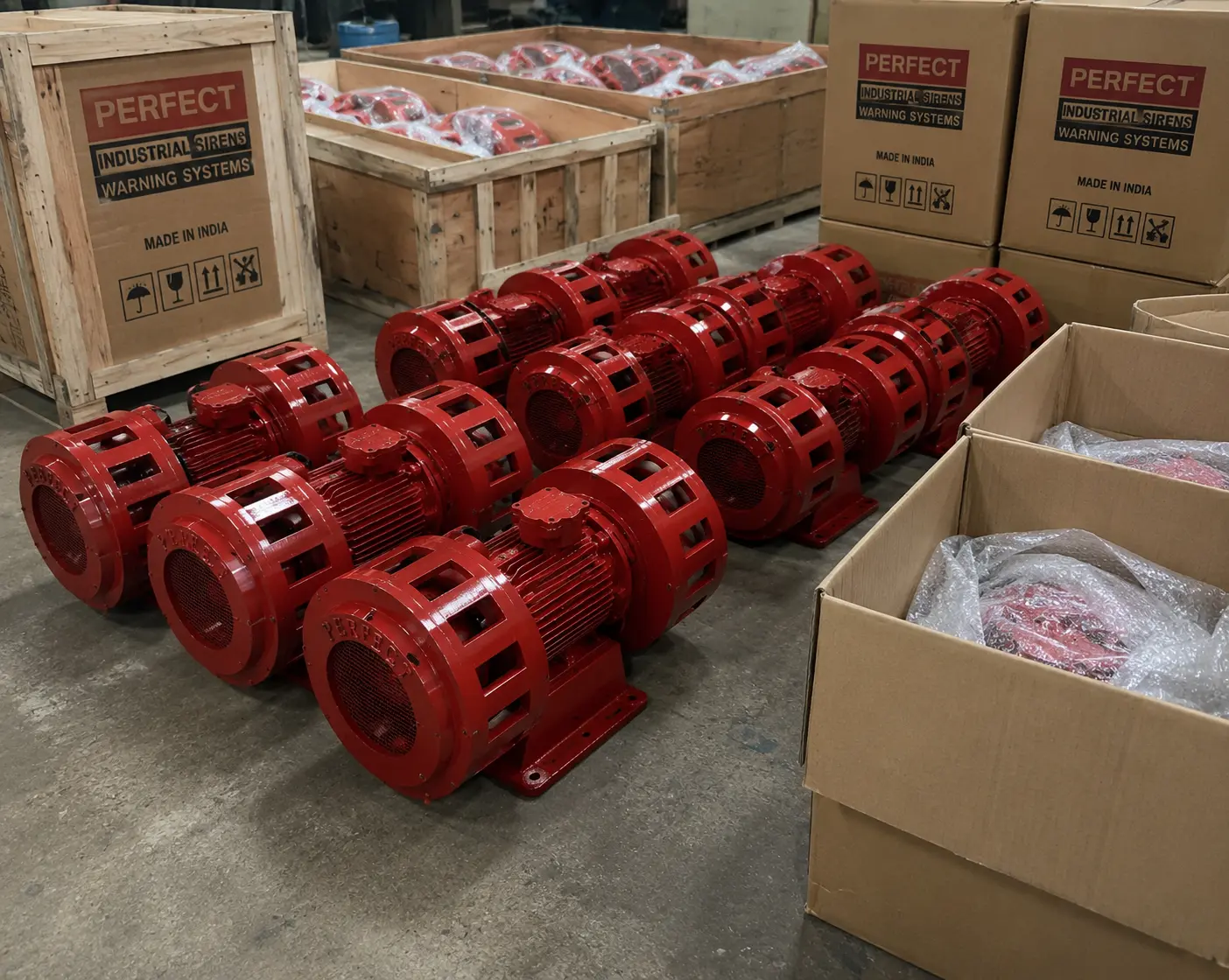
Both are industrial alarm devices. But they solve different problems, perform in different environments, and suit different budgets. This guide compares them across 8 engineering criteria so you can choose correctly — the first time.

Not a marketing comparison — an engineering comparison. Each criterion is scored from 1 (poor) to 5 (excellent) for each siren type.
Motor sirens produce 85–126 dB at 1 metre through a mechanical impeller — raw acoustic power no electronic device can match at a comparable price point. Rated coverage ranges from 0.5 km to 16 km. Electronic sirens produce 90–110 dB through a piezoelectric or electrodynamic speaker — adequate for enclosed spaces and near-field applications up to 200–300m.
The motor siren's mechanical wailing also has better noise penetration characteristics — the swept frequency cuts through broadband industrial noise more effectively than a fixed-frequency electronic tone at the same dB level.
Motor sirens produce two primary tones: straight (continuous wail) and warbling (variable speed wail). That is all. The mechanical nature of the device limits tonal variation to what the motor and impeller geometry can produce.
Electronic sirens produce 12 to 32 distinct tones — fire alarm, ambulance, police, bell, pulse, sweep, chime, and many more — selectable by DIP switch. For applications requiring multiple distinct signals (shift start, break, lunch, emergency) from one device, electronic sirens are the only practical choice.
Motor sirens require a dedicated mast or pole at 6–15m height, armoured cable sized for starting current (3–5× running current), appropriate starter or contactor, and in many cases civil work for the mast foundation. Three-phase models require a four-wire supply. Installation is a 2–3 day job for a skilled electrician.
Electronic sirens are wall or ceiling mounted, weigh under 2 kg, require only a 230V supply and a trigger wire, and can be installed in under an hour with basic tools. No mast, no armoured cable, no special starter needed.
Motor sirens require annual maintenance: bearing inspection and lubrication, carbon brush inspection and replacement (standard motors), impeller housing cleaning, shaft alignment check, and mounting bolt inspection. Carbon brushless motors extend intervals to 18–24 months but still require periodic checks. Maintenance must be done by a skilled technician.
Electronic sirens are solid-state with no moving parts. Maintenance is limited to periodic cleaning and an operational test. Annual service is a 15-minute visual check and functional test — no specialist required.
In environments above 85 dB ambient noise — steel mills, mining, heavy fabrication, stamping shops — motor sirens are the only practical choice. The high raw output (110–126 dB) combined with the frequency-swept mechanical wail gives audible warning at distances where electronic sirens are completely masked by ambient noise.
Electronic sirens in high-ambient environments are not just inadequate — they create a false sense of security. Workers and managers believe the siren will warn them in an emergency, but in practice the alarm is inaudible above the production noise.
Motor sirens have higher capital cost (unit + mast + electrical installation) but cover large areas — one 5 km motor siren may replace 10–15 electronic units for outdoor perimeter coverage. For large outdoor zones, the motor siren is often more cost-effective per square metre of coverage.
Electronic sirens have low capital cost and near-zero maintenance cost. For small indoor zones or moderate-noise environments, they are significantly cheaper than motor sirens — both to buy and to run. The right comparison is cost per zone, not unit price.
Motor sirens integrate with fire panels and DCS/SCADA systems via a relay contact — the relay energises the motor starter, which starts the siren. This works reliably but is a one-bit interface: the siren is either on or off. Tone selection is not possible through this interface.
Electronic sirens accept dry contact inputs directly and can support multiple input channels for different tone codes — fire panel triggers tone 1 (fire alarm), gas detector triggers tone 2 (gas alarm), manual button triggers tone 3 (all clear). This multi-input tone selection is a significant advantage for OISD/ERDMP panel integration.
Standard variants of both motor and electronic sirens are NOT suitable for Zone 1 or Zone 2 hazardous areas. Motor sirens produce sparks at the carbon brushes; electronic sirens may have non-intrinsically-safe circuits. For hazardous locations, a certified flameproof (Ex-d) variant is mandatory for both types.
Flameproof motor sirens and flameproof electronic hooters are available — both require PESO/CIMFR certification for use in Indian hazardous area installations. The selection between flameproof motor and electronic follows the same criteria as non-hazardous: coverage range and ambient noise level are the primary factors.
Six common scenarios from our installation experience — and what we recommended in each case.
Ambient noise 94 dB during rolling. Coverage required across 600m plant diameter. One 10 km motor siren at 12m mast covers the entire site with 6 dB margin.
Ambient noise 62 dB. Coverage 80m × 40m clean room. Electronic siren (100 dB, 12 tones) wall-mounted centrally. Shift change and fire alarm use different tones. Simple, low maintenance.
3 × 16 km motor sirens for outdoor perimeter (ERDMP). 8 × electronic hooters for control rooms, admin, and lab. Motor sirens wired to ASC panel. Electronic units wired to fire panel.
Ambient noise 88–96 dB in grinding area. Outdoor site. Shift change automation + emergency. 2 × 5 km motor sirens at opposite ends, both wired to automatic controller for shift change.
Ambient noise 55 dB. Each floor needs shift timing announcements. 6 × electronic sirens (one per floor), all wired to a single voice announcement controller. Professional, minimal disruption.
Outdoor yard (75 dB): 1 × 2 km motor siren. Indoor processing (65 dB): 3 × electronic sirens with different tones for shift change vs fire alarm. Hybrid system, one ASC panel controlling all.
Tell us your coverage distance, ambient noise, and application. We will specify the right type and model.