Understanding Real Siren Coverage
"This siren has a 5 km range, so it will cover my entire factory" is the single most common misunderstanding in siren selection. Siren range is not a fixed, guaranteed distance — it is a theoretical figure measured under ideal conditions that rarely exist on a real industrial site.
Myth: "This siren has a 5 km range, so it will cover my entire factory."
Reality: Siren range is NOT fixed. It depends entirely on real-world site conditions and installation practice.
What the Quoted Range Actually Means
The quoted range printed on any siren datasheet (2 km / 3 km / 5 km / 8 km, etc.) is:
- Measured in ideal laboratory conditions, not on your factory floor
- Measured in still air, with no wind to carry or scatter the sound
- Measured with no obstacles — no buildings, sheds, walls, or trees in the way
- Expressed as a diametrical coverage figure — a circle radius drawn from the siren as centre point
Real-world coverage is always lower than the quoted figure. Treat the rated range as a ceiling, never as a guarantee.
Key Factors That Affect Siren Audibility & Range
| Factor | What It Does |
|---|---|
| Installation Height | Recommended minimum 40–60 feet. Higher mounting = wider coverage. Lower mounting = restricted, shadowed sound. |
| Wind Direction & Pressure | Sound travels further with the wind and weakens significantly against the wind. |
| Obstructions | Walls, sheds, and trees block sound. It does not pass easily through RCC, metal, or closed structures. |
| Ambient Noise Levels | High machine noise reduces audibility — workers near loud machines may not hear the siren clearly at all. |
| Location of Installation | Central and elevated placement gives better coverage. Corner placement gives poor coverage. |
Hooters vs Motor Sirens
| Parameter | Hooters | Motor Sirens |
|---|---|---|
| Sound Frequency | High-pitched | Low-pitched |
| Sound Travel | Easily blocked, covers smaller area | Less blocked, covers larger area |
| Sound Direction | More focused, covers specific area | Omnidirectional, 360° wide coverage |
| Size & Power | Smaller, less power | Bigger, more powerful |
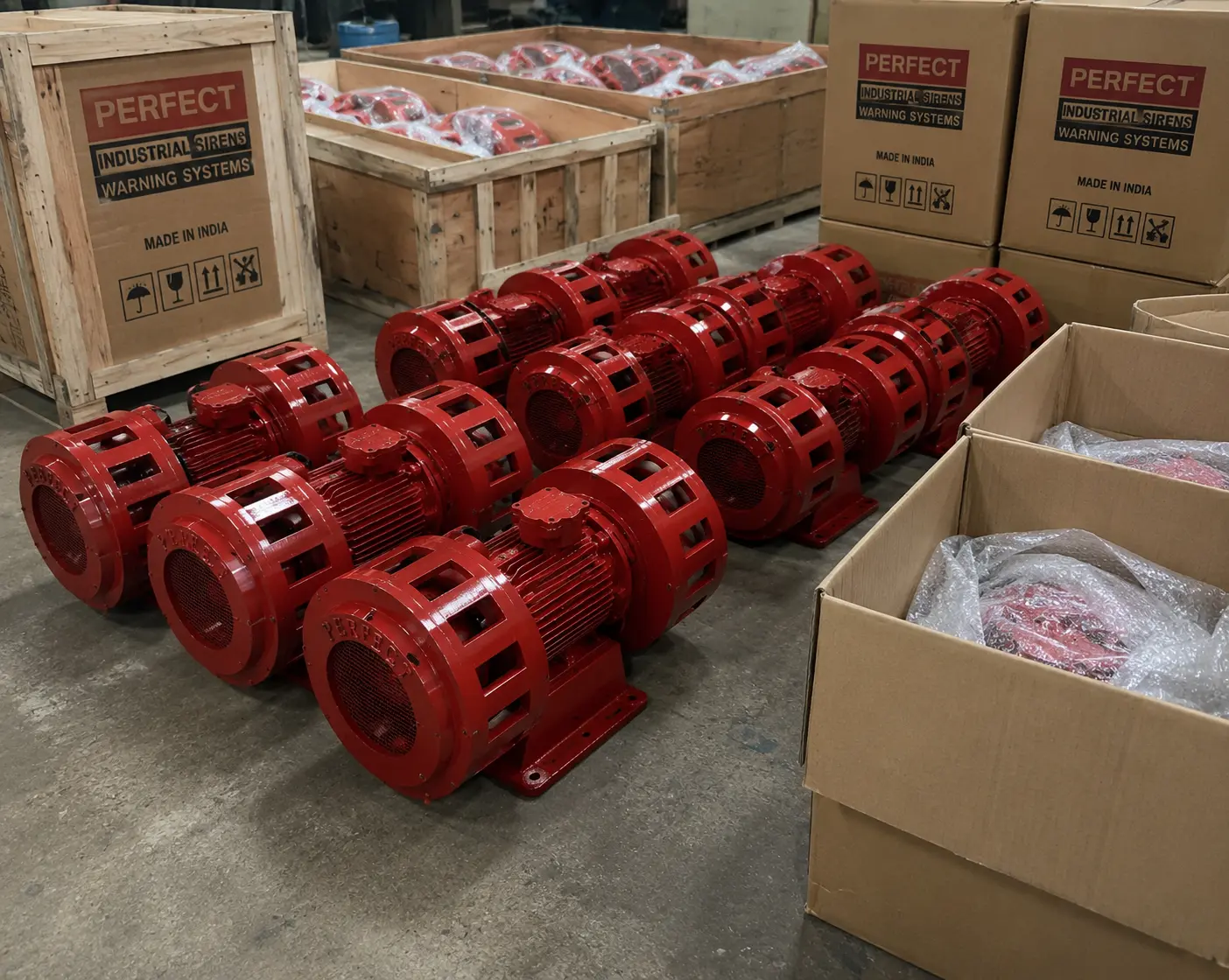
Low-frequency motor sirens travel farther, spread better, and perform well in industrial environments — this is why they remain the standard choice for outdoor perimeter and high-noise zone coverage.
Why dB Alone Is Misleading
dB (decibel) only tells you the loudness measured at exactly 1 metre from the siren. It does not tell you:
- How far the sound will actually travel from that point
- How well it will perform under real site conditions
- How it behaves in wind, ambient noise, or against obstacles
What actually matters for real coverage: frequency/pitch (lower travels farther), sound dispersion pattern, installation height, and environmental obstructions.
Siren installed at: Security gate corner
Expectation: Audible across the entire plant and inside all sheds
Reality: Long distance reduces sound. Shed walls block the noise. Machine noise inside the sheds overpowers the siren. Result: poor or no audibility inside the sheds.
A "2 km siren" produces approximately 112 dB at 1 metre. At 500m with zero ambient noise, this delivers 112 − 54 = 58 dB. Add 92 dB factory ambient noise and the signal-to-noise ratio is only 58 − 92 = −34 dB — completely inaudible. The rated range figure is only meaningful in quiet environments.
Best Practice — Don't Rely on One Siren
The reliable solution is multiple strategically placed sirens, not one large siren expected to cover everything. A practical layout combines a high-power motor siren mounted over the shed roofline to cover the external/open area, with smaller internal sirens or hooters placed inside each shed to cover the internal area where machine noise and walls would otherwise block an external siren. This combination ensures complete, reliable coverage rather than a single point of failure.
Zone Mapping
A zone is a defined area within your facility that requires independent siren coverage. Zones are determined by acoustic isolation (buildings block sound between zones), occupancy type (different noise levels or warning requirements), and safety classification (hazardous area vs general area).
Zone Mapping Methodology
- Walk the entire site during peak production and measure ambient noise at 10–15 points using a calibrated sound level meter (dB(A) fast weighting)
- Identify acoustic barriers — thick walls, large equipment, and buildings that block sound propagation between areas
- Mark each distinct area with its peak ambient noise reading and maximum worker distance from the proposed siren location
- Classify each zone: high noise (>85 dB) → motor siren; medium noise (70–85 dB) → electronic siren; low noise (<70 dB) → electronic siren or voice announcement
- Identify any hazardous areas (Zone 1/2) — these require separate flameproof siren specification
- Determine if zones need independent activation or simultaneous site-wide coverage
Siren Selection Guide
Siren selection depends on four criteria evaluated together: coverage range required, ambient noise level, environment type, and application (emergency warning, shift change, or both).
| Ambient Noise | Coverage Needed | Environment | Recommended |
|---|---|---|---|
| <70 dB (office/hospital) | <100m | Indoor | Voice announcement system or electronic siren (low output) |
| 70–80 dB (light factory) | 100–300m | Indoor | Electronic siren, 90–100 dB model |
| 80–90 dB (medium factory) | 200–500m | Indoor/outdoor | Electronic siren (high output) or 500m–1km motor siren |
| 85–95 dB (heavy industry) | 500m–2km | Outdoor | 2–5 km rated motor siren at 6m+ height |
| 90–100 dB (steel/mining) | 500m–2km | Outdoor | 5–10 km rated motor siren at 10m+ height |
| Any (Zone 1/2 hazardous) | Any | Any | PESO/CIMFR certified flameproof variant — mandatory |
This table provides indicative guidance. Always perform a site-specific calculation using actual ambient noise measurements before finalising selection.
ERDMP & OISD Siren Codes
ERDMP (Emergency Response and Disaster Management Plan) and OISD-117 mandate specific siren tone patterns for each type of emergency event. These patterns must be programmed into your siren control panel and communicated to all workers through drills and posted charts.
The following codes are standard under ERDMP/OISD — always verify the specific codes applicable to your facility with your competent authority, as some installations specify variations.
| Event / Button | Description | Siren Pattern |
|---|---|---|
| 🔴 Fire | Fire emergency — immediate evacuation of affected area. Activates fire response team. | Wailing — 30s ON, 15s OFF × 3 cycles (total 2 min) |
| 🟠 Disaster / Gas Leak | Major disaster or toxic gas release — site-wide evacuation to muster point. | Wailing — 2 min continuous, repeated 3 times with 1-min gaps |
| 🟢 All Clear | Emergency resolved — safe to return to work areas or stand down response teams. | Straight (steady) continuous run — 2 minutes |
| 🔵 Test / Warbling | Monthly test signal — alerts workers this is a drill, not a real emergency. | Warbling — ON 30s, OFF 15s (single cycle only) |
| ⚪ Manual Switch | Direct manual override — siren remains ON for as long as button/switch is held. | Continuous — on while switch depressed |
Shift change sirens must use a distinctly different tone pattern from any ERDMP emergency code. If the same wailing pattern is used for shift change and fire emergency, workers become desensitised and fail to respond appropriately in real emergencies. This is a documented cause of fatalities in industrial accidents. Design your shift change tone to be clearly different — a steady pulse or intermittent beep, never a wailing pattern.
Posting Siren Codes
OISD-117 requires siren code charts to be posted at all main entry points, control rooms, fire stations, and muster points. The chart must include the sound pattern description, the event it represents, and the required action for each code. Workers must be trained on the codes during induction and tested annually.
OISD-117 Compliance Checklist
The following checklist covers the key requirements of OISD-117 for emergency siren systems at petroleum industry facilities. This is indicative — always refer to the full standard and your statutory consultant for facility-specific requirements.
- Emergency siren audible at all points within the facility boundary, minimum 10 dB above ambient noise
- Separate siren control panel with clearly marked emergency buttons for each alarm category
- Manual override capability that functions independent of automatic controls
- Distinct siren tone patterns for fire, disaster, all-clear, and test — no shared patterns
- Backup power supply (UPS/battery) ensuring minimum 30-minute siren operation during power failure
- Siren control panel located in a continuously manned area or fire station
- Integration with fire detection system (automatic trigger on confirmed fire alarm)
- Weatherproof siren units suitable for outdoor installation at the facility
- Annual test with sound level measurement at defined test points — results documented
- Siren code chart posted at all entry points, muster areas, and control rooms
- Worker training on siren codes during induction and annually thereafter
- Maintenance log maintained for all siren equipment
- For hazardous areas (Zone 1/2): PESO/CIMFR certified flameproof siren units mandatory
Our Advanced Siren Control Panel (ASC) is designed to meet OISD-117 and ERDMP requirements — configurable siren codes, dry contact inputs for fire panel integration, manual override, event logging, and supply of compliance documentation. We have 4500+ installations at oil, gas, and petrochemical facilities across India.
Installation Notes
Mounting Height
Every additional metre of mounting height increases effective coverage radius by approximately 15–20% due to reduced acoustic shadowing from structures and equipment. The minimum recommended mounting height is 6 metres above the highest surrounding obstruction. For large outdoor sites, 10–15 metre masts are standard.
- Mount at minimum 6m above the highest surrounding structure within 50m
- For coastal or high-wind locations, calculate mast load at rated wind speed before specifying mast diameter
- Maintain minimum 500mm clearance from walls and structures to avoid acoustic reflection issues
- For multiple sirens on the same mast, minimum 2m vertical separation between units
Electrical Installation
- Use armoured cable (SWA) for all siren power supply runs — unarmoured cable is vulnerable to damage
- Motor siren cables must be sized for starting current, not running current — 3–5× rated running current at start
- Install a dedicated MCB for each siren — never share with other loads
- Earthing at the siren body and at the starter panel — two independent earth connections
- For outdoor runs, maintain minimum IP55 rating at all junction boxes
Post-Installation Verification
- Measure sound level at all defined test points during first activation — document results
- Verify each siren tone code fires correctly from the control panel
- Test manual override function independently of scheduled control
- Confirm emergency button labels match the siren code chart posted at the panel
- Test backup power operation — isolate main supply and verify siren fires on battery
Common Mistakes in Siren System Design
These are the most frequent errors we encounter when reviewing or auditing existing siren installations — and how to avoid each one.
Selecting siren by rated range, not by ambient noise calculation
The most common error. A "5 km siren" does not guarantee 5 km coverage in a factory with 95 dB ambient noise. Coverage is a function of ambient noise, mounting height, and terrain — not just the siren's rated range. Always calculate required output at the farthest zone boundary before selecting.
✓ Fix: Calculate using the formula in Section 1. Apply a minimum 10 dB margin above ambient.Using identical tone patterns for shift change and emergency
Workers who hear the same wailing pattern three times a day for shift changes learn to ignore it. When a real fire occurs, the muscle memory response is to wait — not evacuate. This is not a theoretical risk; it has caused fatalities. Siren codes must be distinct, and workers must be trained on the difference.
✓ Fix: Design shift change as a non-steady continuous tone (steady pulse or intermittent). Reserve wailing for ERDMP emergency codes only.Installing sirens without a zone map
A single siren placed at the administration building may have perfect coverage in the car park and zero coverage in the production hall 200 metres away behind a concrete wall. Without a zone map and sound level verification, coverage gaps go undetected until an emergency exposes them.
✓ Fix: Draw a zone map before selecting siren locations. Verify with a sound level meter post-installation.Mounting sirens too low
Sirens mounted at 3–4 metres are acoustically shadowed by equipment, vehicles, and buildings. The effective coverage radius at 4m height is 40–60% of the coverage achievable at 8–10m height. Low mounting is one of the most persistent problems we find in retrofit audits.
✓ Fix: Minimum 6m above highest surrounding structure. Use dedicated mast if building height is insufficient.No backup power for the siren system
Power failures often coincide with industrial accidents — the same fault that causes a fire or explosion can trip the main power supply. A siren system with no battery backup is silent exactly when it is most needed. OISD-117 mandates 30 minutes minimum backup — most well-designed systems provide 60 minutes.
✓ Fix: Specify UPS or battery backup for the siren control panel. Size for 60 minutes at rated load.Need a Design Review?
If you have an existing siren system and want it audited against OISD-117 or ERDMP requirements, we offer engineering reviews. Share your site layout, existing siren specifications, and control panel details — we will identify gaps and recommend improvements.
Request Engineering Review